
 Ja
Ja  +81-3-6259-1713
IMACEL Case Studies
Support Case#05
Novel approaches to animal behaviour analysis using AI ~Advanced behavioural insights and precise quantification~
Challenge
Conventional animal behaviour analysis typically involves evaluators entering the animal housing room to directly observe animals or using specialized setups such as mazes or rotarod tests that differ from their normal housing environment.
While animal studies remain essential for new drug research and development, they present several challenges, including issues of reproducibility, objectivity, and their relevance to human biology.
Other limitations include the inability to monitor behavior during periods when staff are not present (such as at night) and the variability in assessment results that arises from differences in observer skill and experience.
LPIXEL’s Solution – AI Technology and Impact
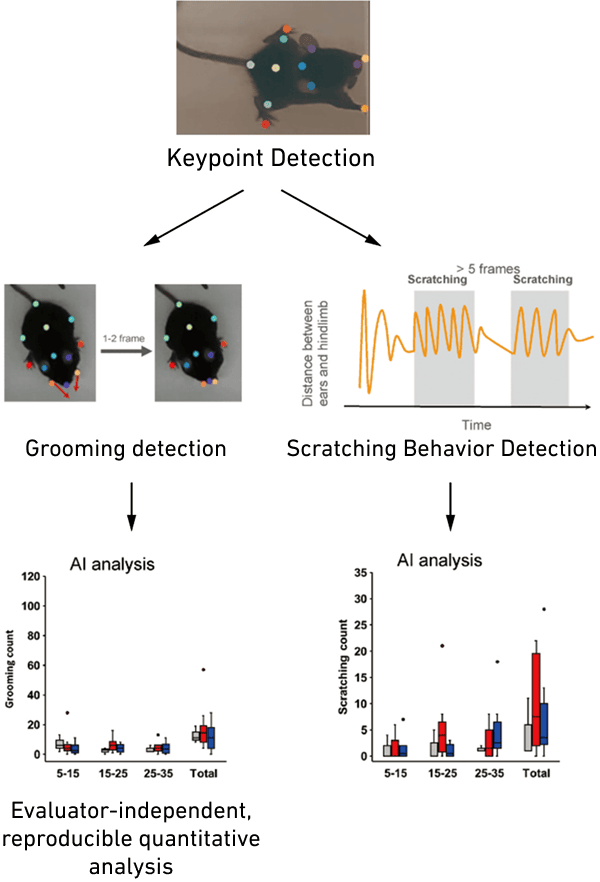
By extracting anatomical key points from video—such as the ears, nose, limbs, and tail—a wide range of behavioural parameters can be derived, such as posture and movement speed. This enables both a comprehensive understanding of each specimen’s behavioral characteristics and precise quantitative analysis of specific actions (e.g., tremors or pruritic behavior).
For example, behaviors characteristic of disease model animals can be detected, allowing for more accurate and quantitative behavioral assessment in pharmacodynamic/pharmacological studies than is achievable with conventional methods.
Additionally, as part of the general observation of animals in safety testing, we aim to reliably identify drug-induced behavioral changes—such as altered activity levels or gait abnormalities.
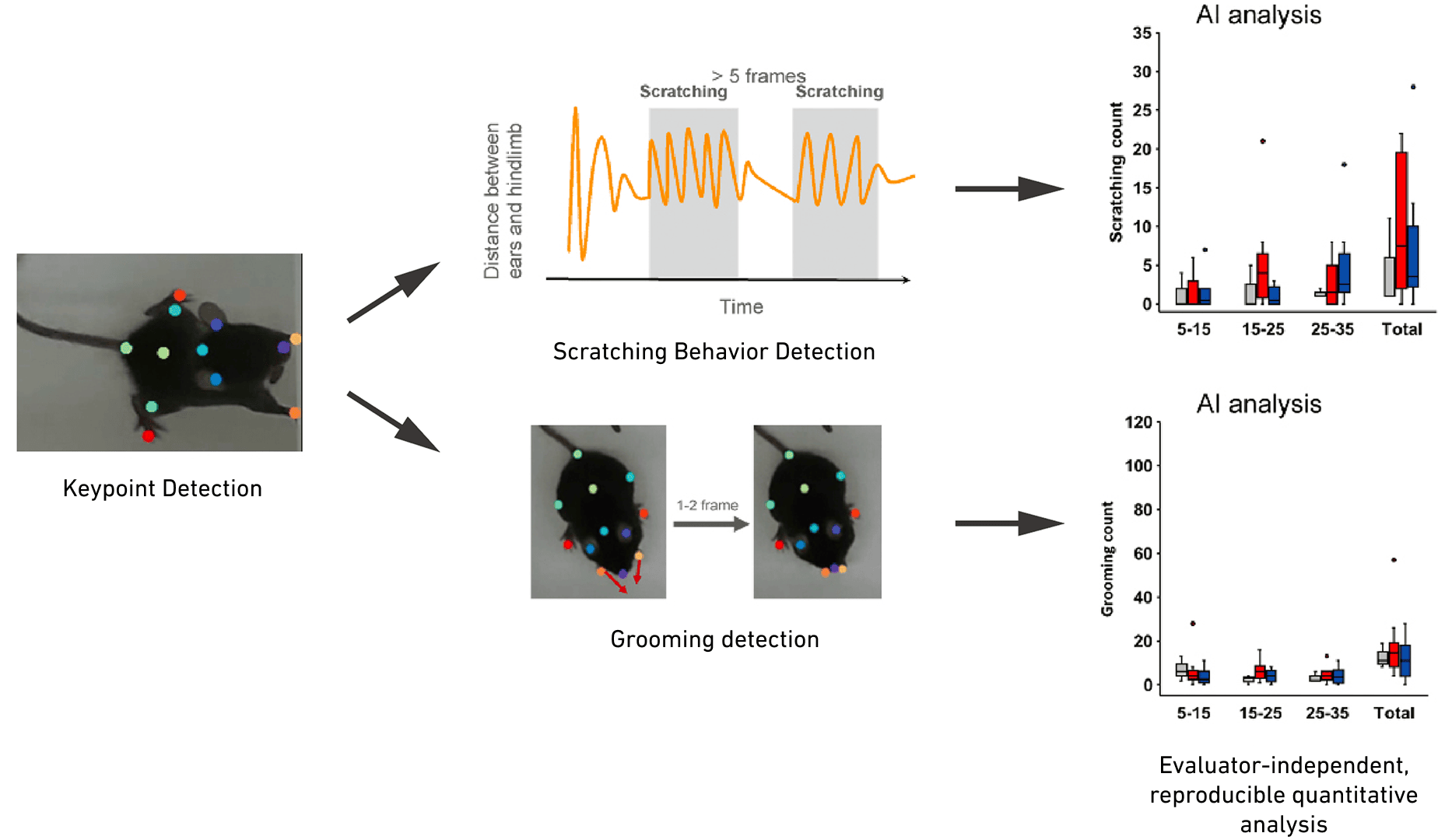
Comparative study of mouse itching behavior evaluation using AI analysis
— Joint presentation with TransGenic Inc.
The 130th Annual Meeting of the Japanese Association of Anatomists,
the 102nd Annual Meeting of the Physiological Society of Japan,
and the 98th Annual Meeting of the Japanese Pharmacological Society, 2025
第130回日本解剖学会・第102回日本生理学会・第98回日本薬理学会合同大会「AI 解析を用いたマウス掻痒行動評価の比較検討」(株式会社トランスジェニックとの共同発表・2025年)
Support Case#01
Phenotypic Screening
~Identifying candidate compounds via cell morphology analysis~
Support Case#02
Automated fluorescent multiplex immunohistochemistry image analysis
~Applied to anticancer drug research and development (R&D) and spatial analysis of the tumor microenvironment.~
Support Case#03
Pathology specimen analysis
~Abnormality screening and virtual staining~
Support Case#04
Automated Light-Sheet Microscopy Image Analysis
~Automatic Brain Region Segmentation and Improved Efficiency in Perivascular Environment Analysis~
Support Case#05
Novel approaches to animal behaviour analysis using AI
~Advanced behavioural insights and precise quantification~
Support Case#06
Automated Micronucleus Test Evaluation
~Provided as an automatic analysis service~
Support Case#07
Automation of Chromosomal Abnormality Detection
~Applications in dose assessment and genotoxicity testing following radiation overexposure~
Support Case#08
Ice Crystal Analysis in the Freeze-Drying Process
~Optimizing Manufacturing Processes with AI~
Support Case#09
Lab Automation Support
~Integrating image-analysis AI into automated medium-scale synthesis systems~

 Request Information