
 Ja
Ja  +81-3-6259-1713
IMACEL Case Studies
Support Case#07
Automation of Chromosomal Abnormality Detection ~Applications in dose assessment and genotoxicity testing following radiation overexposure~
Challenge
Chromosomal translocations are known to be an important index in patient follow-up and biological dosimetry after radiation overexposure. When exposed to a relatively lower dose of ionizing radiation, the frequency of chromosomal aberrations is less than 1%, yet it is necessary to observe 5,000 metaphase cells per patient. Even when using high-throughput microscopy systems, conventional methods rely on expert researchers visually inspecting chromosomal images, resulting in significant time and labor requirements for analysis.
LPIXEL’s Solution – AI Technology and Impact
A deep-learning model for chromosomal aberration detection was developed and evaluated using multi-color FISH images. Specimens were prepared from human peripheral blood irradiated with 2.0 Gy of ⁶⁰Co gamma rays, and the AI model was trained on 505 metaphase images containing more than 21,000 chromosomes. The model achieved over 95% accuracy in chromosome detection and up to 75% accuracy and recall in classifying aberrations such as chromosomal translocations. An analysis of 1,000 chromosome images can be completed in under five minutes, demonstrating the potential for a significant improvement in efficiency compared with conventional manual inspection. We will continue to develop a user-friendly analysis system, aiming to contribute to rapid dose assessment following radiation overexposure and to chromosomal aberration research in the field of clinical cytogenetics. This technology can also be applied to chromosomal aberration testing in drug discovery research.
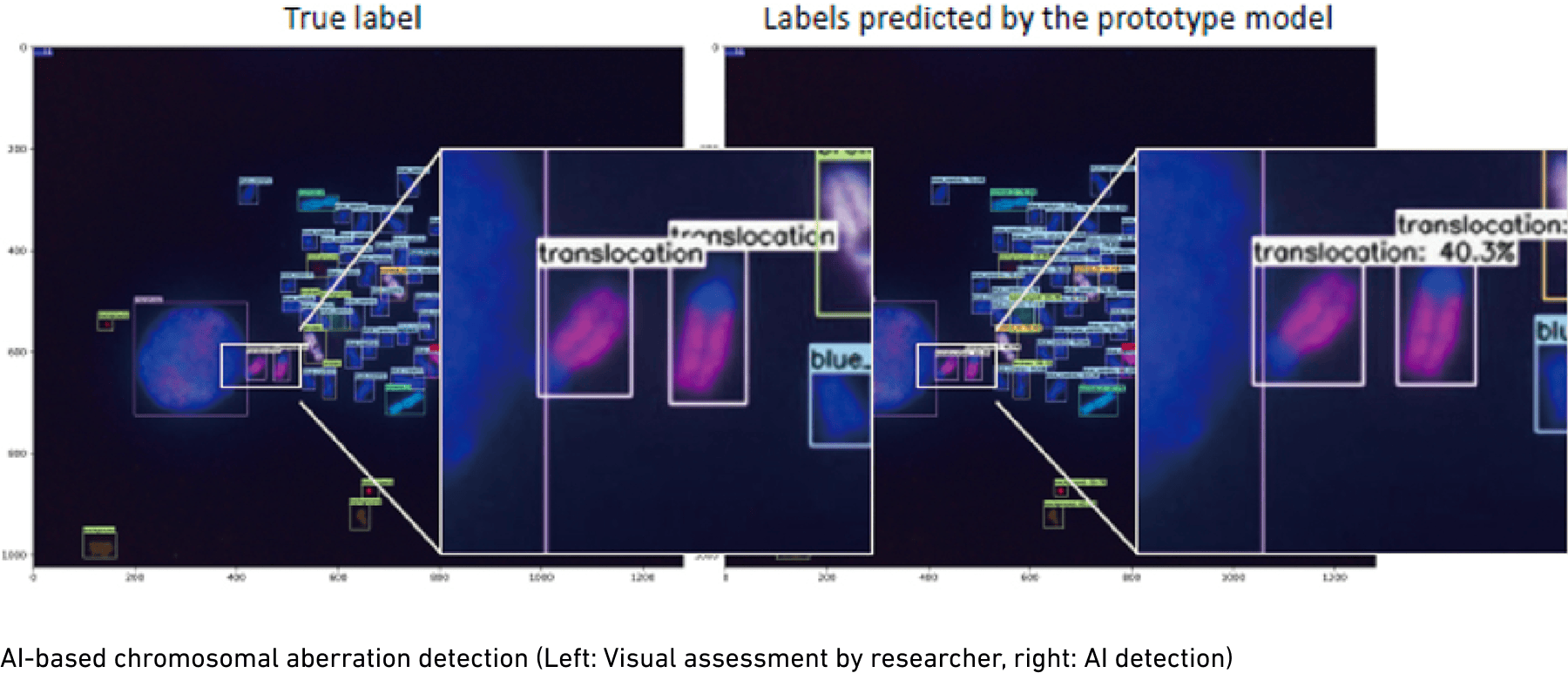
Development of prototype models using deep learning and FISH techniques for chromosomal aberration detection — Joint presentation with the National Institutes for Quantum Science and Technology(EPRBioDose, 2024)
Support Case#01
Phenotypic Screening
~Identifying candidate compounds via cell morphology analysis~
Support Case#02
Automated fluorescent multiplex immunohistochemistry image analysis
~Applied to anticancer drug research and development (R&D) and spatial analysis of the tumor microenvironment.~
Support Case#03
Pathology specimen analysis
~Abnormality screening and virtual staining~
Support Case#04
Automated Light-Sheet Microscopy Image Analysis
~Automatic Brain Region Segmentation and Improved Efficiency in Perivascular Environment Analysis~
Support Case#05
Novel approaches to animal behaviour analysis using AI
~Advanced behavioural insights and precise quantification~
Support Case#06
Automated Micronucleus Test Evaluation
~Provided as an automatic analysis service~
Support Case#07
Automation of Chromosomal Abnormality Detection
~Applications in dose assessment and genotoxicity testing following radiation overexposure~
Support Case#08
Ice Crystal Analysis in the Freeze-Drying Process
~Optimizing Manufacturing Processes with AI~
Support Case#09
Lab Automation Support
~Integrating image-analysis AI into automated medium-scale synthesis systems~

 Request Information