
 Ja
Ja  +81-3-6259-1713
IMACEL Case Studies
Support Case#04
Automated Light-Sheet Microscopy Image Analysis ~Automatic Brain Region Segmentation and Improved Efficiency in Perivascular Environment Analysis~
Challenge
Lightsheet microscopy is a valuable approach for visualizing the entire mouse brain and observing the three-dimensional distribution of target substances within it, enabling the analysis of drug distribution at cellular resolution.
However, this three-dimensional data poses challenges for data analysis due to both the massive data volume and non-uniformity of fluorescence intensity.
In particular, manually extracting vascular structures from large-scale fluorescence images is highly time-consuming and thus requires automation, yet conventional luminance-based thresholding methods alone have proved inadequate.
LPIXEL’s Solution – AI Technology and Impact
LPIXEL, in collaboration with Daiichi Sankyo Co., Ltd., has developed a machine-learning–based method for extracting and analyzing fluorescently labeled vascular structures across the entire mouse brain from three-dimensional lightsheet microscopy images.
This includes an automated workflow that segments brain regions and quantifies the distinctive vascular features within each region.
Furthermore, we are currently developing methods for the three-dimensional analysis of the perivascular environment, including metrics such as the distance between blood vessels and surrounding cell nuclei.
Together, these innovations will enable highly detailed analyses of fluorescently labeled drug distribution and are expected to reveal mechanisms of action that were previously undetectable using conventional analytical approaches.
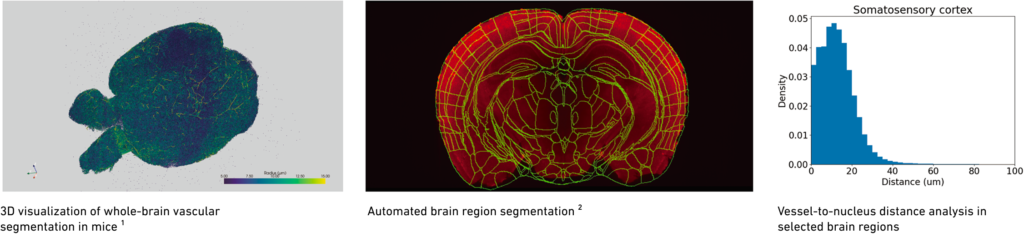
1. Bumgarner JR, and Nelson RJ. (2022). Open-source analysis and visualization of segmented vasculature datasets with VesselVio. Cell Rep Methods 2, 100189. doi: 10.1016/j.crmeth.2022.100189
2. Wang X et al. (2021). Bi-channel image registration and deep-learning segmentation (BIRDS) for efficient, versatile 3D mapping of mouse brain. Elife Jan 18;10:e63455. doi: 10.7554/eLife.63455
<Presentation>
Vascular network analysis across the whole mouse brain via light-sheet microscopy and AI-based image analysis
— Joint presentation with Daiichi Sankyo Co., Ltd. (Society for Neuroscience — Neuroscience 2023, 2023)
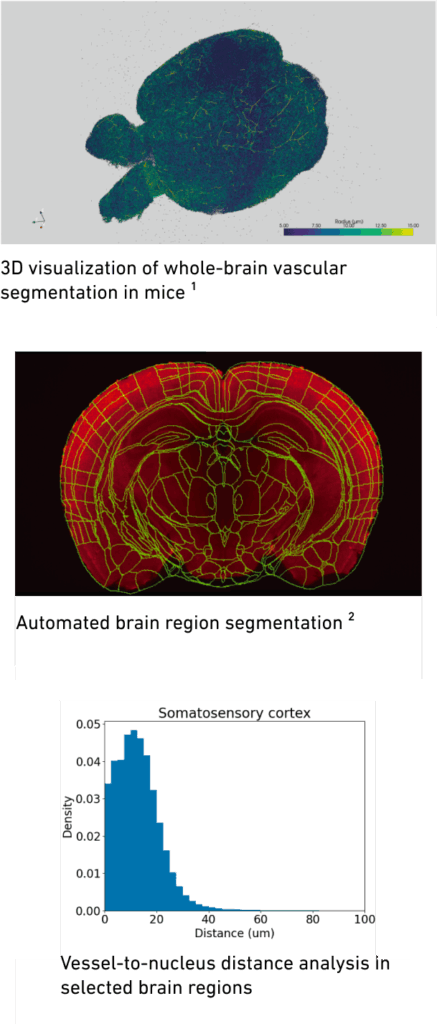
2. Wang X et al. (2021). Bi-channel image registration and deep-learning segmentation (BIRDS) for efficient, versatile 3D mapping of mouse brain. Elife Jan 18;10:e63455. doi: 10.7554/eLife.63455 を解析に利用
<公表実績>
SOCIETY for NEUROSCIENCE’s Neuroscience 2023 “Vascular Network Analysis across the Whole Mouse Brain via Light-sheet Microscopy and AI-Based Image Analysis”(第一三共株式会社との共同発表・2023年)
Support Case#01
Phenotypic Screening
~Identifying candidate compounds via cell morphology analysis~
Support Case#02
Automated fluorescent multiplex immunohistochemistry image analysis
~Applied to anticancer drug research and development (R&D) and spatial analysis of the tumor microenvironment.~
Support Case#03
Pathology specimen analysis
~Abnormality screening and virtual staining~
Support Case#04
Automated Light-Sheet Microscopy Image Analysis
~Automatic Brain Region Segmentation and Improved Efficiency in Perivascular Environment Analysis~
Support Case#05
Novel approaches to animal behaviour analysis using AI
~Advanced behavioural insights and precise quantification~
Support Case#06
Automated Micronucleus Test Evaluation
~Provided as an automatic analysis service~
Support Case#07
Automation of Chromosomal Abnormality Detection
~Applications in dose assessment and genotoxicity testing following radiation overexposure~
Support Case#08
Ice Crystal Analysis in the Freeze-Drying Process
~Optimizing Manufacturing Processes with AI~
Support Case#09
Lab Automation Support
~Integrating image-analysis AI into automated medium-scale synthesis systems~

 Request Information