
 Ja
Ja  +81-3-6259-1713
IMACEL Case Studies
Support Case#06
Automated Micronucleus Test Evaluation ~Provided as an automatic analysis service~
Challenge
The micronucleus test is one of the standard assays used to evaluate chromosomal damage–induced toxicity (genotoxicity). It is primarily conducted to assess the risk of cancer and genetic disorders by measuring the frequency of micronuclei—small, extranuclear bodies that form when chromosomal fragments fail to be incorporated into daughter nuclei during cell division—in treated cell populations. Traditionally, this test has relied on manual microscopic observation, where researchers visually evaluate each cell. This approach imposes a heavy workload and can lead to inter-observer variability in results.
LPIXEL’s Solution – AI Technology and Impact
LPIXEL’s Automated Micronucleus Test Assessment Technology uses a deep-learning AI model trained on the evaluation criteria of skilled experimenters to automatically analyze specimen images and generate assessment reports through the two-step process outlined below.
Automatic identification of individual cells
Determine the presence or absence of micronuclei in the detected cells, and quantification of the incidence rate.
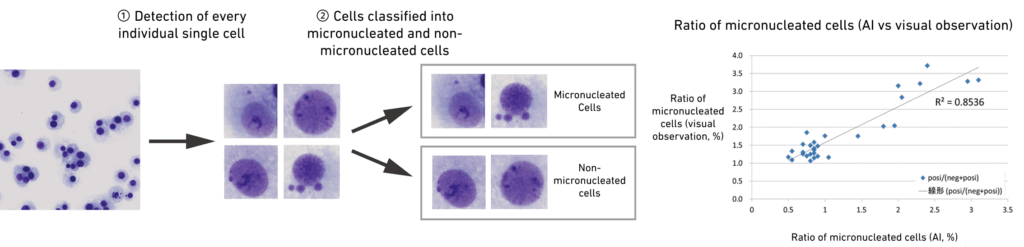
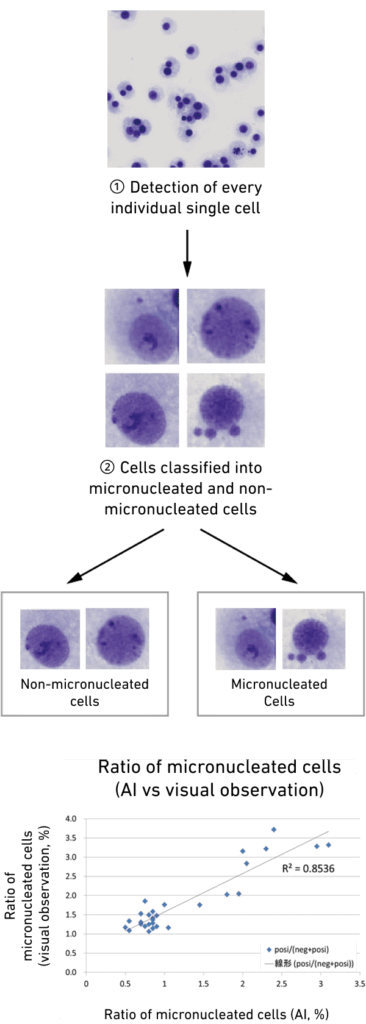
Supported tests: May-Giemsa stain, acridine orange stain (other tests available upon consultation)
This service has been employed by pharmaceutical companies, CROs, and manufacturers in the food and cosmetics industries.
<Achievements / publications>
Validation of automated observation techniques for in vitro micronucleus assay slides using deep learning
— Joint presentation with Takeda Pharmaceutical Company Limited
(Workshop of the Japanese Environmental Mutagen and Genome Society, 2021)
Examination of automated micronucleus observation using AI-based image analysis — Joint presentation with Shiseido Co., Ltd. (The 49th Annual Meeting of the Japanese Society of Toxicology, 2022)
Investigation of automated analysis of micronucleus tests using a three-dimensional human epidermis model with AI-based analysis
— Joint presentation with Shiseido Co., Ltd. (The 52nd Annual Meeting of the Japanese Society of Toxicology, 2025)
Support Case#01
Phenotypic Screening
~Identifying candidate compounds via cell morphology analysis~
Support Case#02
Automated fluorescent multiplex immunohistochemistry image analysis
~Applied to anticancer drug research and development (R&D) and spatial analysis of the tumor microenvironment.~
Support Case#03
Pathology specimen analysis
~Abnormality screening and virtual staining~
Support Case#04
Automated Light-Sheet Microscopy Image Analysis
~Automatic Brain Region Segmentation and Improved Efficiency in Perivascular Environment Analysis~
Support Case#05
Novel approaches to animal behaviour analysis using AI
~Advanced behavioural insights and precise quantification~
Support Case#06
Automated Micronucleus Test Evaluation
~Provided as an automatic analysis service~
Support Case#07
Automation of Chromosomal Abnormality Detection
~Applications in dose assessment and genotoxicity testing following radiation overexposure~
Support Case#08
Ice Crystal Analysis in the Freeze-Drying Process
~Optimizing Manufacturing Processes with AI~
Support Case#09
Lab Automation Support
~Integrating image-analysis AI into automated medium-scale synthesis systems~

 Request Information